Sony launched the Mylo 2 Personal Communicator to little fanfare recently, and Akihabara scored their very own unit for a hands-on Mylo 2 experience. That hugely beautiful 3.5 inch WVGA display is mated to a slide-out QWERTY keyboard with a 1.3 megapixel camera, WiFi (802.11 a/b/g), Skype support, 1GB on-board storage, Memory Stick Duo/PRO Duo card slot.
The Sony Mylo 2 apparently sports a perfectly sliding QWERTY keyboard, has an incredible display, responds quickly, and feels good in the hand. Unfortunately, video playback at a dismal 320 x 240 pixels puts the glorious 800 x 480 screen to shame.
Hit the hands-on video for more…
Source
Showing posts with label Communicator. Show all posts
Showing posts with label Communicator. Show all posts
Wednesday, April 09, 2008


Tuesday, January 01, 2008
Review: Nokia's Thousand-Dollar E90 Communicator Cell Phone
By Jamie Lendino

As opposed to Nokia's multimedia-focused N-series, the E-series focuses on messaging. In Nokia-speak, that basically means these devices have QWERTY keyboards.
The reality is that this unit is quite capable as a multimedia device, just as the company's N-series phones are also excellent e-mail handlers, despite their numeric-only keypads. 
Any way you slice it, this is a precision-engineered instrument for those who can spare more than a grand and have extra-large pockets. 
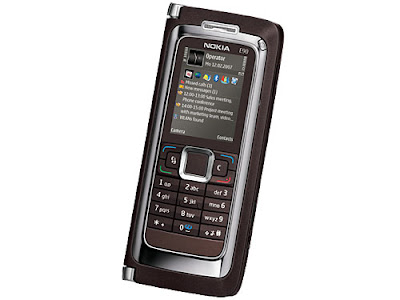
The E90 may be a big phone, but all that bulk is put to good use. On the outside, there's a 2-inch QVGA screen with 320-by-240-pixel resolution. Its backlit numeric keypad sports large, clearly labeled keys with just the right amount of resistance. 
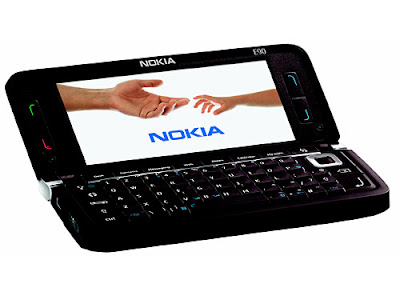
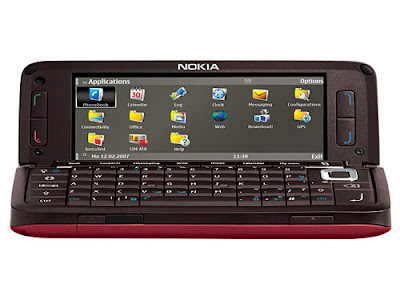
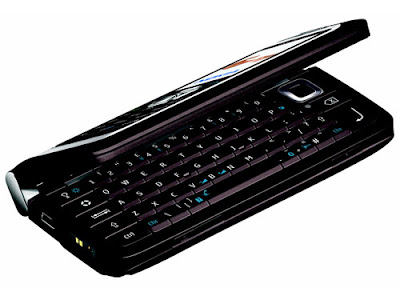
The horizontal flip-style handset opens to reveal a lovely 4-inch, 800-by-352-pixel widescreen and a luxurious, five-row QWERTY keyboard. There's also an extra row of shortcut keys across the top for contacts, messaging, the Web, and other tasks.
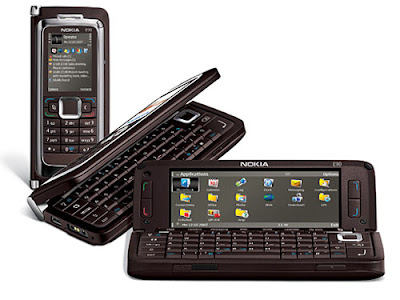
The E90 uses a smooth two-position hinge mechanism so you can flip the device open 90 degrees like a miniature laptop, or lock it at 180 degrees for easy handheld use.
Unlike the numeric keypad, the QWERTY keyboard isn't backlit — but that's its only flaw.
With its excellent feel, dedicated symbol buttons, large space bar and Enter keys, plus dedicated numbers across the top, I was able to type very easily on the E90, though it's a little too wide to hold comfortably for long periods.
Unlike the AT&T Tilt, the device lets you type (with two fingers) while it's sitting on a flat surface, as if it's a mini-laptop. Neither of the E90's screen supports touch, but the five-way navigation pad is accurate and has a crisp feel for moving the display cursor.
The E90 is a quad-band GSM phone (850/900/1800/1900 MHz), making it useful for world travelers, although it supports only the 2100-MHz band for 3G data speeds overseas.
Here in the U.S., we're still stuck with EDGE, the same network used by Nokia's two-year-old 9500 Communicator. That's forgivable on the $449 Nokia E61i, our current Editors' Choice for unlocked handsets, but not so easy to pardon on a $1,099 smartphone.
Its built-in Wi-Fi radio works with WPA and WPA2 networks, and I had no trouble connecting to my own protected WPA network. The E90 practically flew over Wi-Fi, with test speeds ranging from 1750 to 1825 Kbps.
The E90 is one of the best-sounding cell phones I've reviewed: I could hear perfectly clearly and folks on the other end thought I sounded great. Two separate callers even thought I was using a landline.
The device's excellent noise rejection meant that I could walk outside on a windy day — or even right past a road construction crew with a jackhammer, in one case — and continue a conversation.
Reception was also top-notch, and calls were loud and clear through an Aliph Jawbone Bluetooth headset.
The E90's speakerphone is loud enough for outdoor use. It can make VoIP calls in a Wi-Fi hot spot, but my review unit wasn't activated for that purpose, so I wasn't able to test this function. The handset also includes push-to-talk capabilities for those who enable it.
Since the E90 is a Symbian Series 60 3rd edition phone, it will work with thousands of third-party applications. My testing software, JBenchmark ACE, detected an ARM9 processor running at 244 MHz; in use, the E90 felt a bit sluggish compared with a BlackBerry or Palm OS device.
The included Nokia PC Suite software lets you back up data, use the E90 as a slow EDGE modem for your laptop and move files back and forth from your computer.
You can also do the latter with microSD cards up to 4GB in size. Keep in mind, though, that the E90 doesn't support higher-capacity microSDHC cards.
The E90 also sports a built-in GPS radio along with Nokia Maps and Landmarks applications.
The built-in music player had no problem with a variety of MP3, WMA, AAC and even iTunes Plus AAC files, which were a problem on earlier Nokia smart devices like the E61i.
Nokia bundles a set of earphones that sounded poor with music tracks. The E90's volume control also lacks range, and with the included earphones, files recorded at lower levels played back too quietly even at the maximum setting.
Paired with a set of stereo Etymotic Ety8s, I heard clear sound with decent bass and none of the usual swirling audio artifacts I usually hear over stereo Bluetooth. A built-in FM radio and voice recorder round out the unit's audio capabilities.
For video, there's a built-in RealPlayer client that supports MPEG-4 and 3GP in addition to RealPlayer video files. Test video files — including full-length movies — played perfectly smoothly, even when expanded to fill the internal screen.
The E90 employs two cameras. The main camera is a 3.2-megapixel sensor with an LED flash and Nokia's software autofocus. My test unit took colorful, detailed images with low contrast. Unfortunately, the adjustable LED flash had virtually no effect.
I was able to record fuzzy but well-lit 640-by-480-pixel video files at a smooth 30 frames per second. There's also a VGA QCIF camera on the front of the device for video calls and self-portraits.
Many Nokia smartphones feature sophisticated e-mail handling, and the E90 is no exception. You get support for POP, IMAP and Nokia's free Intellisync application, which synchronizes messages, calendar and contact information with Microsoft Exchange and Lotus Domino and also adds push e-mail.
There's a text-to-speech message reader app, along with a PDF reader and Zip Manager for handling e-mail attachments.
The built-in IM client is far from user-friendly. Instead of including profiles for AIM, MSN and other popular services, it speaks in terms of servers, access points and Web addresses, and is unnecessarily difficult to configure.
Nokia bundles in a copy of Quickoffice, which lets you create, edit and save Microsoft Word, Excel and PowerPoint documents, a boon given the E90's incredibly comfortable input features. Its widescreen makes editing spreadsheets a cinch.
Test worksheets, Word documents, presentation files and PDFs all looked accurate, although the built-in Quickword can't deal with Track Changes mode. You'll need to upgrade to Quickoffice Premier 4 to gain that ability.
There's also no video-out for giving presentations or watching movies.
Nokia's enterprise support for the E90 is robust. Along with the aforementioned e-mail capability, the device includes a bar-code reader that uses the built-in camera as a scanner. You can also secure memory cards with passwords, and lock the handset remotely by sending a text message to the unit.
With a T-Mobile SIM card, the E90 lasted a solid 11 hours 23 minutes in a talk-time rundown test, which is plenty of time for long flights and days of endless meetings.
At an eye-popping $1,099, the E90 certainly isn't for everyone. It's a bit larger and heavier than just about any other smartphone on the market, but given the device's extensive capabilities, I didn't mind that so much.
At 7.4 ounces it's still significantly lighter than hybrid devices such as the 12.6-ounce HTC Advantage, which falls somewhere between a laptop and cell phone.
That makes the E90 infinitely more suitable as your only phone, and one that could also suffice in lieu of a laptop for short trips, as long as you don't need it for writing long documents or giving presentations.
Nokia should have added HSDPA 3.6 support for the E90 in the U.S., not only because of the device's stratospheric price, but also because its long battery life would likely fare better than the Nokia N95 (U.S.) did on our 3G-enabled endurance test.
Still, the E90 is a jewel of a gadget. There are plenty of less-expensive handsets with dual keyboards, including the powerful AT&T Tilt and nonsmart models like the LG Voyager.
But globetrotting corporate mavens of means can buy this smartphone with confidence — and know it will pretty much do it all.
Editor's rating: Three and a half out of five stars.
[via FOXNews]

If you're looking for the Grand Poobah of smartphones, look no further than Nokia's new $1,099 E90 Communicator.
As opposed to Nokia's multimedia-focused N-series, the E-series focuses on messaging. In Nokia-speak, that basically means these devices have QWERTY keyboards.
The reality is that this unit is quite capable as a multimedia device, just as the company's N-series phones are also excellent e-mail handlers, despite their numeric-only keypads.
The unlocked E90 is a much-improved follow-up to the clumsy 9300 and 9500 Communicators.
Along with stellar voice quality, the E90 includes dual screens, dual keyboards, Wi-Fi, Bluetooth 2.0 and GPS, plus an entire suite of applications that would cost significantly more with other smartphones.
Any way you slice it, this is a precision-engineered instrument for those who can spare more than a grand and have extra-large pockets.
The E90's sturdy matte aluminum-and-plastic enclosure feels great in the hand. At 5.2 by 2.2 by 0.8 inches (HWD) and a hefty 7.4 ounces, you certainly won't mistake this beast for a slim RAZR2.
The E90 may be a big phone, but all that bulk is put to good use. On the outside, there's a 2-inch QVGA screen with 320-by-240-pixel resolution. Its backlit numeric keypad sports large, clearly labeled keys with just the right amount of resistance.
The horizontal flip-style handset opens to reveal a lovely 4-inch, 800-by-352-pixel widescreen and a luxurious, five-row QWERTY keyboard. There's also an extra row of shortcut keys across the top for contacts, messaging, the Web, and other tasks.
The E90 uses a smooth two-position hinge mechanism so you can flip the device open 90 degrees like a miniature laptop, or lock it at 180 degrees for easy handheld use.
Unlike the numeric keypad, the QWERTY keyboard isn't backlit — but that's its only flaw.
With its excellent feel, dedicated symbol buttons, large space bar and Enter keys, plus dedicated numbers across the top, I was able to type very easily on the E90, though it's a little too wide to hold comfortably for long periods.
Unlike the AT&T Tilt, the device lets you type (with two fingers) while it's sitting on a flat surface, as if it's a mini-laptop. Neither of the E90's screen supports touch, but the five-way navigation pad is accurate and has a crisp feel for moving the display cursor.
The E90 is a quad-band GSM phone (850/900/1800/1900 MHz), making it useful for world travelers, although it supports only the 2100-MHz band for 3G data speeds overseas.
Here in the U.S., we're still stuck with EDGE, the same network used by Nokia's two-year-old 9500 Communicator. That's forgivable on the $449 Nokia E61i, our current Editors' Choice for unlocked handsets, but not so easy to pardon on a $1,099 smartphone.
Its built-in Wi-Fi radio works with WPA and WPA2 networks, and I had no trouble connecting to my own protected WPA network. The E90 practically flew over Wi-Fi, with test speeds ranging from 1750 to 1825 Kbps.
The E90 is one of the best-sounding cell phones I've reviewed: I could hear perfectly clearly and folks on the other end thought I sounded great. Two separate callers even thought I was using a landline.
The device's excellent noise rejection meant that I could walk outside on a windy day — or even right past a road construction crew with a jackhammer, in one case — and continue a conversation.
Reception was also top-notch, and calls were loud and clear through an Aliph Jawbone Bluetooth headset.
The E90's speakerphone is loud enough for outdoor use. It can make VoIP calls in a Wi-Fi hot spot, but my review unit wasn't activated for that purpose, so I wasn't able to test this function. The handset also includes push-to-talk capabilities for those who enable it.
Since the E90 is a Symbian Series 60 3rd edition phone, it will work with thousands of third-party applications. My testing software, JBenchmark ACE, detected an ARM9 processor running at 244 MHz; in use, the E90 felt a bit sluggish compared with a BlackBerry or Palm OS device.
The included Nokia PC Suite software lets you back up data, use the E90 as a slow EDGE modem for your laptop and move files back and forth from your computer.
You can also do the latter with microSD cards up to 4GB in size. Keep in mind, though, that the E90 doesn't support higher-capacity microSDHC cards.
The E90 also sports a built-in GPS radio along with Nokia Maps and Landmarks applications.
The built-in music player had no problem with a variety of MP3, WMA, AAC and even iTunes Plus AAC files, which were a problem on earlier Nokia smart devices like the E61i.
Nokia bundles a set of earphones that sounded poor with music tracks. The E90's volume control also lacks range, and with the included earphones, files recorded at lower levels played back too quietly even at the maximum setting.
Paired with a set of stereo Etymotic Ety8s, I heard clear sound with decent bass and none of the usual swirling audio artifacts I usually hear over stereo Bluetooth. A built-in FM radio and voice recorder round out the unit's audio capabilities.
For video, there's a built-in RealPlayer client that supports MPEG-4 and 3GP in addition to RealPlayer video files. Test video files — including full-length movies — played perfectly smoothly, even when expanded to fill the internal screen.
The E90 employs two cameras. The main camera is a 3.2-megapixel sensor with an LED flash and Nokia's software autofocus. My test unit took colorful, detailed images with low contrast. Unfortunately, the adjustable LED flash had virtually no effect.
I was able to record fuzzy but well-lit 640-by-480-pixel video files at a smooth 30 frames per second. There's also a VGA QCIF camera on the front of the device for video calls and self-portraits.
Many Nokia smartphones feature sophisticated e-mail handling, and the E90 is no exception. You get support for POP, IMAP and Nokia's free Intellisync application, which synchronizes messages, calendar and contact information with Microsoft Exchange and Lotus Domino and also adds push e-mail.
There's a text-to-speech message reader app, along with a PDF reader and Zip Manager for handling e-mail attachments.
The built-in IM client is far from user-friendly. Instead of including profiles for AIM, MSN and other popular services, it speaks in terms of servers, access points and Web addresses, and is unnecessarily difficult to configure.
Nokia bundles in a copy of Quickoffice, which lets you create, edit and save Microsoft Word, Excel and PowerPoint documents, a boon given the E90's incredibly comfortable input features. Its widescreen makes editing spreadsheets a cinch.
Test worksheets, Word documents, presentation files and PDFs all looked accurate, although the built-in Quickword can't deal with Track Changes mode. You'll need to upgrade to Quickoffice Premier 4 to gain that ability.
There's also no video-out for giving presentations or watching movies.
Nokia's enterprise support for the E90 is robust. Along with the aforementioned e-mail capability, the device includes a bar-code reader that uses the built-in camera as a scanner. You can also secure memory cards with passwords, and lock the handset remotely by sending a text message to the unit.
With a T-Mobile SIM card, the E90 lasted a solid 11 hours 23 minutes in a talk-time rundown test, which is plenty of time for long flights and days of endless meetings.
At an eye-popping $1,099, the E90 certainly isn't for everyone. It's a bit larger and heavier than just about any other smartphone on the market, but given the device's extensive capabilities, I didn't mind that so much.
At 7.4 ounces it's still significantly lighter than hybrid devices such as the 12.6-ounce HTC Advantage, which falls somewhere between a laptop and cell phone.
That makes the E90 infinitely more suitable as your only phone, and one that could also suffice in lieu of a laptop for short trips, as long as you don't need it for writing long documents or giving presentations.
Nokia should have added HSDPA 3.6 support for the E90 in the U.S., not only because of the device's stratospheric price, but also because its long battery life would likely fare better than the Nokia N95 (U.S.) did on our 3G-enabled endurance test.
Still, the E90 is a jewel of a gadget. There are plenty of less-expensive handsets with dual keyboards, including the powerful AT&T Tilt and nonsmart models like the LG Voyager.
But globetrotting corporate mavens of means can buy this smartphone with confidence — and know it will pretty much do it all.
Editor's rating: Three and a half out of five stars.
[via FOXNews]
Sunday, December 30, 2007
Nokia E90 Communicator Launched in India

On Thursday, Nokia launched E 90 Communicator, one more phone from E series. The E90 Communicator is the first enterprise phone from Nokia offering email access, web browsing and maps application for location-based services. The E90 also offers business full function, multimedia as well as 3G ability.
The Nokia E90 Communicator is well equipped. It has a 3.2 megapixel auto-focus camera with a flash. Also another QCIF camera that E 90 incorporates is useful for video-calling and conferencing.
The E90 has a foldable style that opens up to a large 800×320 pixel screen with 16m colors and has full QWERTY keypad with buttons on either side of the screen. The external screen features 320×240 pixel resolutions and it also has 16m colors.
Nokia’s new communicator phone sports connectivity options such as WI-FI, HSDPA, HSCSD, infrared, Bluetooth v2.0 with A2DP. Not to forget, USB too. The phone has 128MB of internal memory and can support up to 4GB of external memory using microSD cards.
On the occasion of launch Nokia E90 Communicator, Chakrapani GK, Country General Manager, Nokia Enterprise Solutions, said, “The launch of Nokia E90 Communicator is the tipping point for business mobility in India. Business Mobility has emerged as the biggest reason for enterprises to go mobile as over 60% of business critical decisions are taken ‘on the go’. With the launch of Nokia E90, we are bringing an all together new and expanded view of business
mobility to the market place as well as a culmination of 3Ps - power, performance, productivity.”
He further said, “The Nokia Communicator category has enjoyed a cult status among users worldwide as well as in India. Today, the Communicator user base in India has grown to approximately 150,000 users.”
He further said, “The Nokia Communicator category has enjoyed a cult status among users worldwide as well as in India. Today, the Communicator user base in India has grown to approximately 150,000 users.”
The mobile phone weights 210g, and measures 132 x 57 x 20 mm. The Nokia E 90 will be available in the market at an estimated price of Rs. 43,000.
Friday, August 03, 2007
Nokia E90 Communicator
The good: Solid build quality; numeric keypad in addition to a QWERTY keyboard; Wi-Fi, HSDPA, GPS and Bluetooth stereo; large 800 x 352-pixel screen; supports various messaging clients including BlackBerry Connect; fast processor.
The bad: Typing on the wide keyboard can be tiring after a long while; no fax capability; camera's shutter button doesn't perform up to par.
The bottom line: Strong features and a relatively compact form factor make the E90 Communicator one of the best smart phones in the market today.
Scroll Down for Pictures...
Nokia's Communicators have come a long way as the latest addition to the series, the E90, arrives more than a year after the 9300i Communicator. The E90 packs virtually all the features there are available right now including HSDPA, Wi-Fi, built-in GPS, a 3.2-megapixel camera, large 800 x 352-pixel LCD (not touchscreen, though) and a full QWERTY keyboard.
One of the biggest changes on the E90 from the earlier 9300i is the inclusion of a camera. Nokia explains the main reason for this is to capture a broader audience and also an increasing group of business execs who use their work phones after hours as well. Unlike the 9300i which was based on the older S80 system, the E90 runs on the Symbian Series60 platform which has a more robust interface. Other business smart phones that are on the S60 operating system include the E61 and the E61i, both offering candy-bar form factors compared with the clamshell E90.
DesignWhen there's no need for the QWERTY keyboard, we can rely on the numeric keypad and a 2-inch QVGA screen on the top face. That, however, comes at a price. The E90 isn't the smallest or the lightest smart phone, but we feel its size and weight can be justified by those who want a portable computing device.
Unlike the Dopod U1000 which is also in the mini computer category, we could still fit the E90 snugly into a pants pocket. The build quality is also excellent for this Nokia. However, the faceplate at the back of the E90 didn't gel very well at the top where the speakers are, but we're nitpicking and it could be just our review unit. When we're using the directional pad, delete and enter buttons on the QWERTY, we can feel its hollowness.
On the outside, the E90 is like any other candy-bar phone. In fact, most of the functions are accessible from the 2-inch screen save for a front-facing camera for 3G video calls. The beauty of the E90 shows up only when we open the clamshell and let it sit on the table like a mini laptop.
Accompanying a generous 4-inch 800 x 352-pixel LCD are numerous shortcut buttons for commonly used applications and also two customizable My Own keys for user-specific programs. A QCIF camera sits at the top left corner of this screen for video calls. The QWERTY keyboard is a joy to use although it is still impossible to type with two hands like on a full-size keyboard. Most times we simply used our thumbs or two index fingers to type.
Unlike the E61i and the Dopod C730, the QWERTY on the E90 is considerably wider so our digits have to move across a longer horizontal distance. That could be tiring after a while. That said, the keys provide tactile feedback with a pitch of about 0.5mm (which may be enough for some, but not others). It would have been perfect if there was a more distinct feel between each button. A flaw with the earlier 9300i was that the keyboard didn't light up.
Fortunately, this is corrected on the E90 with a dedicated button to adjust the brightness of the screen and also to light up the QWERTY keyboard. The keyboard lights up with a brightness level that's enough for us to know where each key is, yet isn't too glaring to distract us from the screen.
The bad: Typing on the wide keyboard can be tiring after a long while; no fax capability; camera's shutter button doesn't perform up to par.
The bottom line: Strong features and a relatively compact form factor make the E90 Communicator one of the best smart phones in the market today.
Scroll Down for Pictures...
Nokia's Communicators have come a long way as the latest addition to the series, the E90, arrives more than a year after the 9300i Communicator. The E90 packs virtually all the features there are available right now including HSDPA, Wi-Fi, built-in GPS, a 3.2-megapixel camera, large 800 x 352-pixel LCD (not touchscreen, though) and a full QWERTY keyboard.
One of the biggest changes on the E90 from the earlier 9300i is the inclusion of a camera. Nokia explains the main reason for this is to capture a broader audience and also an increasing group of business execs who use their work phones after hours as well. Unlike the 9300i which was based on the older S80 system, the E90 runs on the Symbian Series60 platform which has a more robust interface. Other business smart phones that are on the S60 operating system include the E61 and the E61i, both offering candy-bar form factors compared with the clamshell E90.
DesignWhen there's no need for the QWERTY keyboard, we can rely on the numeric keypad and a 2-inch QVGA screen on the top face. That, however, comes at a price. The E90 isn't the smallest or the lightest smart phone, but we feel its size and weight can be justified by those who want a portable computing device.
Unlike the Dopod U1000 which is also in the mini computer category, we could still fit the E90 snugly into a pants pocket. The build quality is also excellent for this Nokia. However, the faceplate at the back of the E90 didn't gel very well at the top where the speakers are, but we're nitpicking and it could be just our review unit. When we're using the directional pad, delete and enter buttons on the QWERTY, we can feel its hollowness.
On the outside, the E90 is like any other candy-bar phone. In fact, most of the functions are accessible from the 2-inch screen save for a front-facing camera for 3G video calls. The beauty of the E90 shows up only when we open the clamshell and let it sit on the table like a mini laptop.
Accompanying a generous 4-inch 800 x 352-pixel LCD are numerous shortcut buttons for commonly used applications and also two customizable My Own keys for user-specific programs. A QCIF camera sits at the top left corner of this screen for video calls. The QWERTY keyboard is a joy to use although it is still impossible to type with two hands like on a full-size keyboard. Most times we simply used our thumbs or two index fingers to type.
Unlike the E61i and the Dopod C730, the QWERTY on the E90 is considerably wider so our digits have to move across a longer horizontal distance. That could be tiring after a while. That said, the keys provide tactile feedback with a pitch of about 0.5mm (which may be enough for some, but not others). It would have been perfect if there was a more distinct feel between each button. A flaw with the earlier 9300i was that the keyboard didn't light up.
Fortunately, this is corrected on the E90 with a dedicated button to adjust the brightness of the screen and also to light up the QWERTY keyboard. The keyboard lights up with a brightness level that's enough for us to know where each key is, yet isn't too glaring to distract us from the screen.
Monday, July 30, 2007
Nokia E90 Communicator Smartphone Review
In the recent past, a flurry of new and advanced mobile phones has made their pompous entry into India. And the latest one to join the bandwagon is the Nokia E90 smartphone. But hey this is not just any ordinary mobile device, but a smartphone as it incorporates some truly ‘smart’ and intelligent functions. Undoubtedly an owner’s delight and a neighbor’s envy, that’s what the Nokia E90 exactly is. Read on to know why we seem to be so awed by this multimedia device.
But before we throw the light on the E90, let’s speak a little about the journey of communicators, from what it was to what it now is.

Now coming to the main features of the Nokia E90 smartphone, the device features one of the fastest RAM in a Nokia phone, 128 MB coupled with a faster processor. This enables the phone to work efficiently. You can run several applications in the background without making it slow or freeze. The Nokia E90 is the first communicator to run on a single platform. It has S60 3.1 platform running on Symbian OS 9.2, which allows you to continue with the same action even when you flip screens.
It has a cool QWERTY keyboard that makes web browsing a true delight on this phone. And of course the inner display which is 800 x 352 pixels of size only adds on to the pleasure. The large screen makes the web pages look just as though you are surfing the internet on your PC monitor.

Normally to browse the web from a mobile phone, users have to use a GPRS connection, which sometimes can be expensive depending upon the carrier and the plan or 3G capability, which ironically is not available in all countries including India. However, the Nokia E90 communicator has Wi-Fi capabilities and all you have to do is go into a Wi-Fi hotspot and start surfing.
And of course it does include other basic features such as FM Radio, Media Player. The QWERTY keyboard makes sending SMSes and writing notes very easy. The Nokia E90 has a 3.2 MP camera with which you can click photos and also record videos. It features various different modes and settings that you would normally find in a digital camera. You can also make video calls with your E90. Besides these functions the smartphone has a host of other functions such as Clock, Calendar, GPS, Calculator and Converter. It also comes with a QuickOffice and Adobe PDF that let you view all your office documents. And if you have a printer nearby, you can use the Wi-Fi functionality of the phone to print documents. In addition, it also has a Barcode reader which scans barcodes.
Though the Nokia E90 is close to flawless, but as the old adage goes, “Nothing is perfect,” this device also cannot be given a perfect ten on ten.
Firstly the keys, especially the ones next to the Menu buttons on the front side could have been perhaps a little bigger. There is a lot of space at the bottom and instead of squishing the keys on the top; they could have ergonomically designed the main keypad. Secondly, we would have loved it if there were some more games included in the device. And here’s probably the biggest drawback, or may I say lack that I found in the Nokia E90. After having so many plus points one wonders why the Finnish mobile giant compensated on its memory capacity. Ironically, the phone supports and expandable memory of only up to 2 GB, which we feel is very low considering the fact that these days people do carry a lot of data on their phones. However, here’s some bleak ray of light that we see as there is a possibility of Nokia coming out with a newer version that would support up to 4 GB of expandable memory.
The Nokia E90 India price is Rs. 38,000, (that is around US $940, when converted) which seems like quite an affordable device for such a plethora of features and suave to its look.
But before we throw the light on the E90, let’s speak a little about the journey of communicators, from what it was to what it now is.

The first phone in the Communicator series was the Nokia 9000 that debuted in 1996. After that Nokia released a slew of phones in that line. Phones such as the 9000i, 9110, 9110i, 9210, 9210i, 9290, 9300, 9300i and the 9500 made an appearance. They were called the 9xxx series.
However, it has to be noted that 9300 and 9300i were not considered as Communicators.
Earlier phones in the communicator series were dubbed as Bricks (sorry iPhone, but your misnomer was taken long back) and even as bad as bulky compass boxes.
To begin with, the E90 smartphone is the first device, which is not a Nokia 9xxx series’ model that has been given the tag of Communicator. Coming to its appearance, it comes in two colors, mocha and burgundy (in layman terms, black and red!). As James Bond would say it, ‘first things first’. Yes the first thing that you notice about the E90 is the size. And what a breath of fresh air that seemed to be for sure! It essentially looks like an N70 enclosed in a shell! And if you’ve ever held the old communicators, then you would exactly understand how compact the E90 actually is.
Now coming to the main features of the Nokia E90 smartphone, the device features one of the fastest RAM in a Nokia phone, 128 MB coupled with a faster processor. This enables the phone to work efficiently. You can run several applications in the background without making it slow or freeze. The Nokia E90 is the first communicator to run on a single platform. It has S60 3.1 platform running on Symbian OS 9.2, which allows you to continue with the same action even when you flip screens.
It has a cool QWERTY keyboard that makes web browsing a true delight on this phone. And of course the inner display which is 800 x 352 pixels of size only adds on to the pleasure. The large screen makes the web pages look just as though you are surfing the internet on your PC monitor.
Normally to browse the web from a mobile phone, users have to use a GPRS connection, which sometimes can be expensive depending upon the carrier and the plan or 3G capability, which ironically is not available in all countries including India. However, the Nokia E90 communicator has Wi-Fi capabilities and all you have to do is go into a Wi-Fi hotspot and start surfing.
And of course it does include other basic features such as FM Radio, Media Player. The QWERTY keyboard makes sending SMSes and writing notes very easy. The Nokia E90 has a 3.2 MP camera with which you can click photos and also record videos. It features various different modes and settings that you would normally find in a digital camera. You can also make video calls with your E90. Besides these functions the smartphone has a host of other functions such as Clock, Calendar, GPS, Calculator and Converter. It also comes with a QuickOffice and Adobe PDF that let you view all your office documents. And if you have a printer nearby, you can use the Wi-Fi functionality of the phone to print documents. In addition, it also has a Barcode reader which scans barcodes.
Though the Nokia E90 is close to flawless, but as the old adage goes, “Nothing is perfect,” this device also cannot be given a perfect ten on ten.
Firstly the keys, especially the ones next to the Menu buttons on the front side could have been perhaps a little bigger. There is a lot of space at the bottom and instead of squishing the keys on the top; they could have ergonomically designed the main keypad. Secondly, we would have loved it if there were some more games included in the device. And here’s probably the biggest drawback, or may I say lack that I found in the Nokia E90. After having so many plus points one wonders why the Finnish mobile giant compensated on its memory capacity. Ironically, the phone supports and expandable memory of only up to 2 GB, which we feel is very low considering the fact that these days people do carry a lot of data on their phones. However, here’s some bleak ray of light that we see as there is a possibility of Nokia coming out with a newer version that would support up to 4 GB of expandable memory.
The Nokia E90 India price is Rs. 38,000, (that is around US $940, when converted) which seems like quite an affordable device for such a plethora of features and suave to its look.
Friday, June 29, 2007
Nokia E90 Communicator Available
Nokia India has unveiled the first enterprise phone in the country, the Nokia E90 Communicator, which offers email access, Web browsing, and a Maps application, among others.

The E90 features two cameras: a 3.2 megapixel camera with flash and auto-focus, and a QCIF one for video conferencing.
The phone includes features such as an FM radio, a music player, a video player, 'active notes' for taking notes and tagging them to individual names, 'Quickoffice' for viewing, opening, and editing email attachments, Zip Manager, and Adobe Acrobat Reader.
The Communicator also has an integrated GPS and Nokia Maps application to help users find routes and locate services.
E90 offers fast connections over WLAN and HSDPA with enhanced 3G for mobile use of data and transmission of rich applications.
With the Nokia S60 browser with 16-million colors, the phone is capable of displaying the full width of a Web page at once.
Speaking at the launch, Chakrapani GK, country general manager of Nokia Enterprise Solutions, said, "The launch of Nokia E90 Communicator is the tipping point for business mobility in India. With the launch of Nokia E90, we are bringing an altogether new and expanded view of business mobility to the market place, as well as a culmination of power, performance, and productivity."
The Nokia E90 Communicator is available across the country for Rs 40,499 (inclusive of taxes).
Subscribe to:
Posts (Atom)