Sunday, October 21, 2012

Samsung Galaxy Tab 2 7.0 Review


I like seven-inch tablets very much. They are compact and comfortable devices that can fit into a small bag or even into a jacket pocket. They are also more lightweight and less expensive than ten-inch models. The one we are reviewing here, the Galaxy Tab 2 7.0, represents a logical sequel and extension of the compact tablet lineup by Samsung.

Design, materials & controls
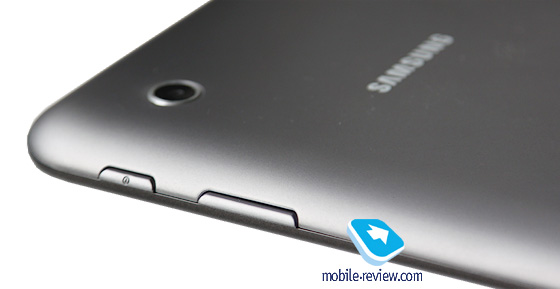
The right side accommodates the volume rocker and the power button. Their travel is short and soft, so the buttons are comfortable to use.

This one resembles many other Samsung tablets, and not only them actually.

On the left, we get slots for a microSD card and a SIM card (in 3G version). Both slots are covered with protecting caps that are perfectly fastened and don't seem to come loose in the future.

On the bottom, we can see the proprietary charging socket also used to connect the device to a PC. On both sides of it, there are speakers, covered with grids, and a microphone. The sound volume produced by the speakers is moderate, but if you hold the tablet horizontally, you may cover them with your hand.
On the top, we have a 3.5-mm audio jack and another microphone.
The entire front panel is occupied by the screen and a black bezel around it; the front camera eyelet and the voice speaker are above the screen.
The tablet also has a rear side camera. The backside itself is made of grey matt plastic that feels nice to the touch and is quite wear-resistant; no scratches appear on it. So we can be glad Samsung decided not to use their favorite glossy plastic for the backside of this tablet.
By the way, the white version of this model also hit the shelves not so long ago.
There are absolutely no complaints about the build quality, unlike the majority of low-end tablets that normally produce lots of creak and crackle, but we get nothing of the kind here.


First Look. Sony LT30p Mint

Introduction
Sony wants to make a strong effort to return to the market as a player both with strong and numerous solutions. Xperia S created a uniqure situation for the company, with only one new device available for more than a month with the rest of the same line up appearing on most markets roughly four weeks ago. This time around Sony is trying to create as many devices as possible with many or just a few differences betweebn them offered at different prices to offer one device for every consumer.
LT30p belongs to this new crop of models and along with Sony Tipo and a couple of other new handsets, which are also to be presented also tries to differentiate itself from the design philosophy that was used in Xperia S and all its junior sibblings. Lt30p aims at the high end maket to be placed as Sony's flahsgip for the third quarter of the year. While practically replacing Xperia S in that place, it has very few similarities both in terms of design and features.

Wednesday, April 18, 2012

Translator App for Windows Phone receives major update – Video Demo


Microsoft’s Windows Phone Bing Translator application has just received a major update.
Within the new update Microsoft has added some great new features like:
Offline Translation – you can download language packs for offline use
Point, Scan and Translate – translate printed language by simply pointing the camera
Type and Translate – instant translations using keyboard input
Speak and Translate – allows users to speak phrases into their phone, the device will then speak back what you just said in the desired language.
You can download Microsoft’s Translator from the Marketplace for free.
Check the video:

Samsung Developing Handset for Windows Phone 8

Samsung is reported to be releasing at least one handset running Windows Phone 8, the upcoming new version of Microsoft’s mobile OS, codenamed Apollo.

According to UnwiredView.com – quoting Chinese website ePrice – Samsung Taiwan has confirmed that an Apollo-based phone will arrive in the second half of 2012. Unwiredview reckons this is not likely before October, as the new version of the WP operating system is not due until around then.
It may be one of three new Windows Phone devices from Samsung. Most of the world is waiting to see what the Korean giant does with the imminent Galaxy S3 handset, and other models in its ever expanding Android range, such as the Galaxy Note.

However, Samsung is clearly trying to keep a broad portfolio of products, while holding off from embracing Windows Phone as much as, say, Nokia with its Lumia range.


Samsung has previous form in this area. Last year it brought out the well-received Omnia 7, running Windows Phone 7 (Mango).

Dream: ON iPhone app to bring you blissful dreams


Wish to enjoy some blissful dreams tonight? A superb iPhone app called the Dream: ON will help you enjoy some perfect reveries. Dream: ON is an effort by professor Richard Wiseman of the University of Hertfordshire, Britain, to see whether pleasant soundscapes could influence one’s dreams. The app just checks users sleep patterns to identify when they slip to REM sleep and play preferred soundscapes to influence dreams, says Wiseman.

Studies have shown that most dreams occur during REM sleep. Your mind will be alert to other senses while you dream and so the soundscapes from your iPhone will naturally boost your dreams. Dream: ON plays the soundscape you have selected before going to bed. The soundtrack will keep your mind ready for dreaming and they will occur as you expected. But the app's developer warns that everyone won't have similar dreams. And so Dream: ON may not be effective for all and it may turn effective for many with few days' practice.
To run the Dream: ON, you are required to choose a particular soundscape from a preloaded list that includes a peaceful garden, ocean and others. It is to predetermine the mood of your dream in the night. After setting all the options, you should place your iPhone face down on the bed. The app will observe your movements during sleep and instigate dreams in you. Soon after, the app will begin to play the specific soundscape, which will lead you to a perfect dream. The app will itself adjust the sound to make sure you are not getting awake. This is what professor Richard Wiseman has to say about the Dream: ON app,\
We have created a new way of carrying out mass participation experiments. We still know relatively little about the science of dreaming and this app may provide a real breakthrough in changing how we dream, and record and track those dreams.
 Apart from helping you have perfect dreams, the app has a fully functional smart alarm, which will let users wake up with a fresh mind. The alarm gently produces voice to wake you up at an optimum moment. Moreover, it has a functionality to record your dreams and sleeping patterns as graphs. In the morning, the app will show a graphical pattern of your sleep movements.
The app also has an option to help you instantly share your dreams and sleeping patterns with friends on social media sites like Twitter and Facebook. The researcher behind Dream: ON is also working to develop a Dream Bank, a social platform where users can share their dreams and read the dreams of their friends. Of course, Dream: ON might be the world's biggest dream experiment ever.

Lava Xolo X900: Intel Medfield-based phone to hit stores next week

Lava International is all set to release the first smartphone with Intel’s newly announced Medfield mobile chips in India. Dubbed the Xolo X900, the phone will run on as-yet-unspecified version of Google Android. The device was originally announced at the Mobile World Congress 2012 by the Lava executives and Intel’s CEO Paul Otellini. Intel has also signed deals with Lenovo, Motorola and Orange besides Lava to produce hardware solutions for its new Atom chips for mobile devices.


The Lava Xolo X900 will tout rich specs under the hood. The device will sport a 4.03-inch touchscreen with decent screen resolution and clarity. Intel’s new Z2460 single core processor with a clock-speed of 1.6GHz will power the gadget. The processor can ensure long battery life (up to 8 hours) with the 3G voice calling. You can enjoy six hours of HD video and five hours of 3G web browsing and 14 hours of standby on single charge.

It seems that Lava would become the first firm in the world to release an Intel Medfield-based device. Lenovo’s WMC 2012-featured K900 smartphone is only to come in May, 2012. Motorola and Orange haven’t yet announced their Intel devices. Thus, Lava Xolo X900 may be the first device with Intel's mobile processor.

The chip maker, which has been dominating the chip market for PCs and servers, wishes to enter into the mobile market with its new range of mobile processors. Mr. Otellini thinks that there is enough space for Intel to get into the mobile industry, which is currently dominated by the Cambridge, U.K-based ARM Holdings. Intel is in efforts to put holes in the supremacy of ARM. The company has already started talks with the leading tech makers like Apple and Samsung to encourage them to use its Medfield chips in their products.

Wednesday, April 11, 2012

Nokia Lumia 610 NFC announced


Today at WIMA in Monaco, Nokia announced their first NFC Windows Phone, Lumia 610 NFC. Nokia’s Andrea Bacioccola explains how people can use NFC on the Lumia 610 NFC.
NFC stands for Near Field Communication and advantages you get with Lumia 610 NFC are being demoed in the video: activating tags by tapping on them and connect to wireless Bluetooth speakers. The Lumia 610 NFC is also certified for contactless payments with MasterCard’s PayPass solution, and with Visa’s mobile application for payments, Visa payWave.

The Lumia 610 NFC is expected to be available early in the third quarter of 2012. Orange will be the first operator to carry the device.

Check the video: